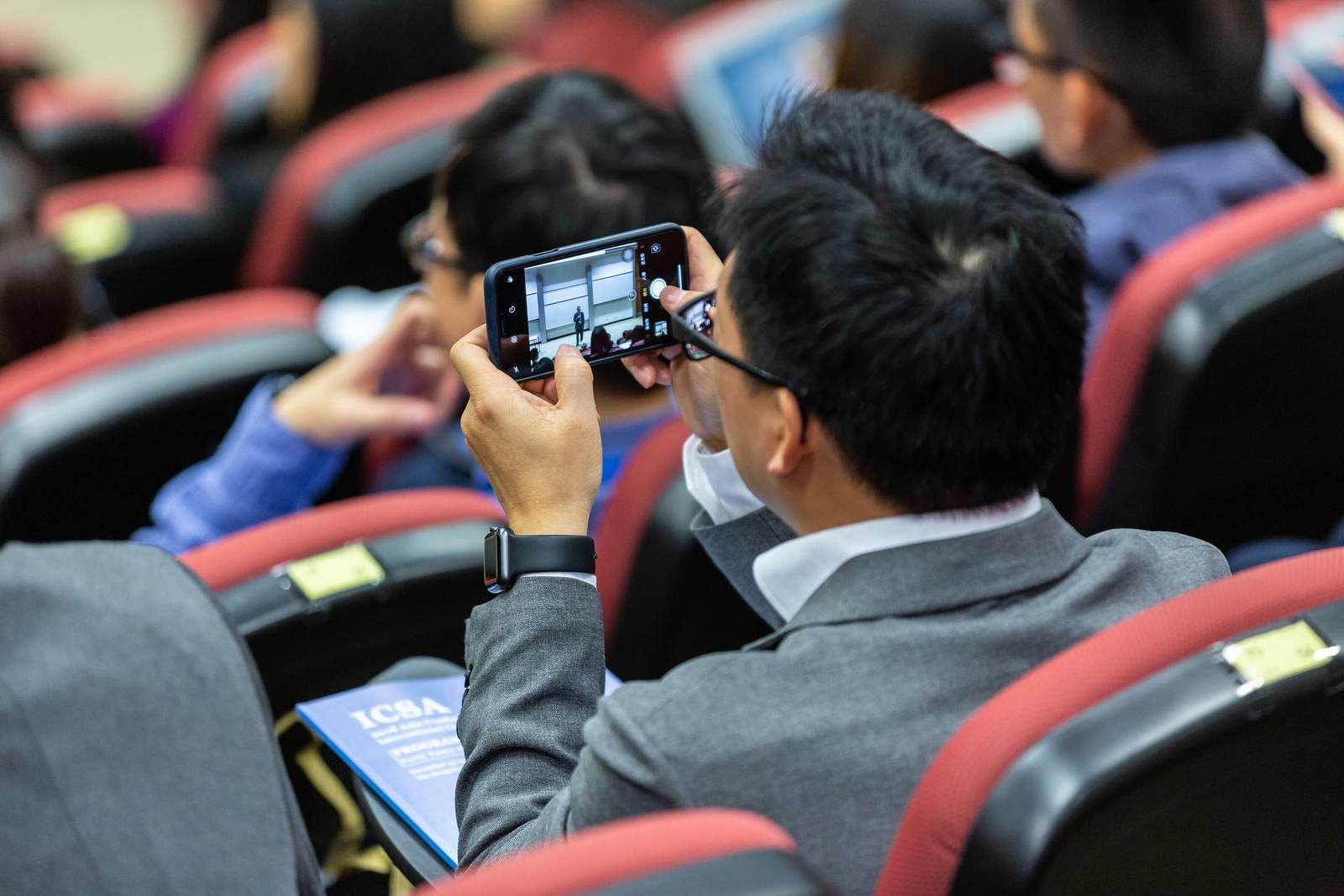

The phone comes up the instant a dense slide appears — a data table, a decision tree, a citation worth chasing down later — and by the third session of the day it has become entirely automatic. Photographing a slide feels like retaining it: the information is captured, safe, filed away for whenever you need it. Mostly it isn't. It's deferred, and deferred information has a way of staying deferred permanently, sitting in a camera roll between a parking receipt and someone's dog, identical to four hundred other rectangles of text nobody will open again.
What the reflex actually saves
The instinct isn't wrong so much as incomplete. A photo is a genuinely good tool for a specific kind of slide — a reference table, a citation list, a diagram with more detail than you can transcribe before the speaker clicks forward. Where it fails is the slide that mattered for what the speaker said about it, not for what was printed on it: a single finding, a single recommendation, a sentence of interpretation that never made it onto the slide at all. Photograph that one and you've preserved a caption with no picture underneath it — technically accurate, functionally useless three weeks later when “IMG_4821” could be any of a dozen sessions.
One line beats one photo
The fix isn't choosing between photographing and note-taking; it's pairing them, on purpose, every time. The moment you take the photo, write one line — not a summary of the slide, but what it means for you: the thing you'd tell a colleague who wasn't in the room. “Their stability data contradicts the guidance we've been assuming” survives being read cold on a Tuesday three weeks later. The photo alone does not. This is the same discipline reading a session's actual format already rewards — a dense technical track produces more of these slides per hour than a panel discussion does, so the habit matters more in some rooms than others.
The same-day sort
A camera roll of forty unsorted slide photos, opened a week after the conference ends, is close to useless — you'll recognize almost none of them, and reconstructing which session each came from costs more time than the photo ever saved. Do the sort the same evening, while the context is still attached to the memory: rename or caption each photo with the session and the one-line takeaway you wrote when you snapped it, and delete the ones that turned out not to matter once you're looking at them again with a clear head. That evening pass is also exactly the raw material a trip report that actually gets read is built from — a report assembled from forty captioned photos the same night writes itself faster than one reconstructed from memory a week later.
When the photo is the wrong tool entirely
Some sessions produce almost nothing worth photographing, and reaching for the phone out of habit in one of them is a tell worth noticing in yourself. A narrative talk, a panel discussion, a regulator explaining the reasoning behind a decision — the value in those rooms is in what's said, not what's projected, and a phone raised toward the screen is often a stand-in for engagement rather than a form of it. At a data-heavy session like an FDA town hall on a technical topic or a dense track at DIA's global annual meeting, the camera earns its keep. In a room built around discussion, put it down and actually listen — the sentence worth keeping usually isn't on the slide at all.
Worth a look in the directory
- RAPS Convergence 2026 — a profession-wide annual with dense concurrent tracks
- DIA 2027 Global Annual Meeting — technical sessions dense enough that photos and notes both earn their keep
- ISPE Pharma 4.0 & Biopharma 2026 — reference-heavy technical content, the kind worth photographing
More from Save the Date
- The trip report that actually gets read
- Conference, workshop, webinar, town hall — what each format is actually built to do
Essays are editorial: they describe how we plan and attend events, not rules. Event listings on this site are verified against the organizer’s own pages — but confirm dates and pricing with the organizer before booking anything.